
The Standard Model Lagrangian is usually shown in one of two forms. The compact one fits on three lines:
\[\begin{aligned} \mathcal{L}_{\mathrm{SM}} = {} & -\tfrac{1}{4} G^{A}_{\mu\nu} G^{A\mu\nu} - \tfrac{1}{4} W^{I}_{\mu\nu} W^{I\mu\nu} - \tfrac{1}{4} B_{\mu\nu} B^{\mu\nu} \\ & + \sum_{\psi} \bar\psi\, i\gamma^{\mu} D_{\mu} \psi + (D_{\mu}H)^{\dagger} D^{\mu} H - V(H) \\ & - \Big( \bar Q_L Y_u \widetilde{H} u_R + \bar Q_L Y_d H d_R + \bar L_L Y_e H e_R + \text{h.c.} \Big) + \mathcal{L}_{\mathrm{gf}} + \mathcal{L}_{\mathrm{ghost}}. \end{aligned}\]
The expanded one — every field written out after electroweak symmetry breaking, in unitary-plus-Goldstone form with Faddeev–Popov ghosts — runs to a full page:
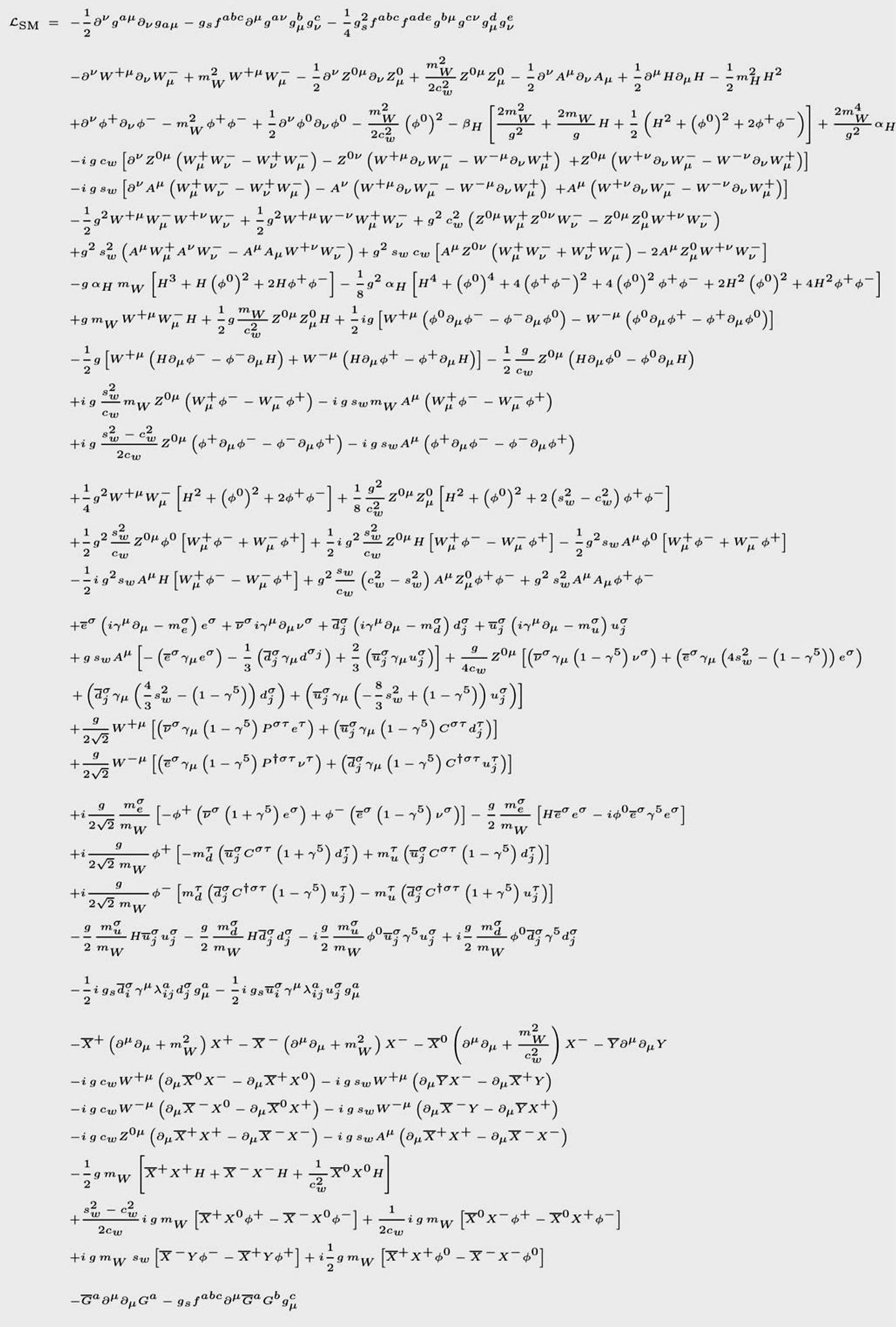
Both are correct transcriptions of the same theory. And both are missing something the universe has.
Read the fermion sector carefully
Look at the third line of the compact form. There are three Yukawa terms: one for up-type quarks (\(Y_u\)), one for down-type quarks (\(Y_d\)), one for charged leptons (\(Y_e\)). There is no \(Y_\nu\). There is no right-handed neutrino field \(\nu_R\) anywhere in the field content, so there is nothing for a neutrino Yukawa to couple to.
The expanded form makes this even more visible. Every charged fermion gets a kinetic term with a mass:
\[\bar e^{\sigma}\left(i\gamma^{\mu}\partial_{\mu} - m_e^{\sigma}\right) e^{\sigma}, \qquad \bar d^{\sigma}_j\left(i\gamma^{\mu}\partial_{\mu} - m_d^{\sigma}\right) d^{\sigma}_j, \qquad \bar u^{\sigma}_j\left(i\gamma^{\mu}\partial_{\mu} - m_u^{\sigma}\right) u^{\sigma}_j.\]
The neutrino gets
\[\bar\nu^{\sigma}\, i\gamma^{\mu}\partial_{\mu}\, \nu^{\sigma}.\]
No mass. Not a small mass, not an unknown mass — the term is absent by construction, because with only \(\nu_L\) in the theory and only renormalizable operators allowed, no gauge-invariant mass term can be written.
The argument in three steps
-
\(\mathcal{L}_{\mathrm{SM}}\) contains no \(\nu_R\) and no neutrino-mass operator \(\;\Longrightarrow\; m_{\nu_1} = m_{\nu_2} = m_{\nu_3} = 0.\)
-
\(m_{\nu_i} = 0 \;\Longrightarrow\;\) the mass basis and the flavour basis can be chosen to coincide, so the flavour-change amplitude is \[\mathcal{A}_{\alpha\to\beta} = \sum_i U_{\beta i} U^{*}_{\alpha i} = (UU^{\dagger})_{\beta\alpha} = \delta_{\beta\alpha},\] and neutrino flavours cannot oscillate.
-
Neutrino flavours demonstrably oscillate \(\;\Longrightarrow\; \Delta m^2_{ij} \neq 0 \;\Longrightarrow\;\) contradiction.
Step 3 is not in dispute. Super-Kamiokande (1998), SNO (2001–2002), KamLAND, Daya Bay, and a generation of long-baseline experiments have measured both mass-squared splittings to percent-level precision. The 2026 Particle Data Group review states plainly that, with the Standard Model's field content, neutrinos are exactly massless, and that neutrino mass requires going beyond it. The same review records the oscillation evidence and explains that oscillations require unequal masses.
Therefore,
\[\boxed{\;\mathcal{L}_{\text{minimal SM}} \neq \mathcal{L}_{\text{complete law of nature}}\;}\]
What "minimal" is doing in that sentence
This is a genuine empirical falsification — but of a specific object: the renormalizable Lagrangian with exactly the field content displayed above. It is not a falsification of gauge theory, of the Higgs mechanism, or of the electroweak sector, all of which continue to pass every test thrown at them.
Repairing it requires adding something absent from the displayed equation. There are two standard routes.
Add a field. Introduce right-handed neutrinos \(\nu_R\) and a fourth Yukawa:
\[-\bar L\, Y_\nu \widetilde{H}\, \nu_R + \text{h.c.}\]
This is renormalizable and mirrors the quark sector exactly. The price is three new gauge-singlet fields that interact with nothing else, and a Yukawa coupling of order \(10^{-12}\) that nobody has a natural explanation for.
Add an operator. Keep the field content and allow the one dimension-five operator compatible with the gauge symmetry — the Weinberg operator:
\[\frac{c_{\alpha\beta}}{\Lambda}\,(L_\alpha H)(L_\beta H) + \text{h.c.}\]
After symmetry breaking this gives a Majorana mass \(m_\nu \sim c\, v^2/\Lambda\), which is naturally tiny if \(\Lambda\) is large. The price is non-renormalizability: the theory now announces a scale \(\Lambda\) beyond which it must be replaced.
Either repair yields a theory beyond the minimal Standard Model. Whether you call the second one "beyond the SM" or "the SM as an effective field theory" is a matter of taste; physicists who work in SMEFT would say the Weinberg operator was always implicitly there, just suppressed. What is not a matter of taste is that the equation on the T-shirt, the mug, and the CERN poster does not describe neutrinos as they are observed.
Why this matters
It is easy to treat the Standard Model Lagrangian as a finished object — the thing we have, with dark matter and gravity as the things we lack. Neutrino mass is a reminder that the gap is inside the equation, not just outside it. It is the only confirmed laboratory-scale failure of the minimal theory, and the one place where the "complete law of nature" is known to require at least one more line.
We do not yet know which line.